Israel Stuck Without Clear Winner
No party bloc reached the 61-seat majority needed for power, leaving three messy paths for forming a government.
By Zoe Ruiz ·

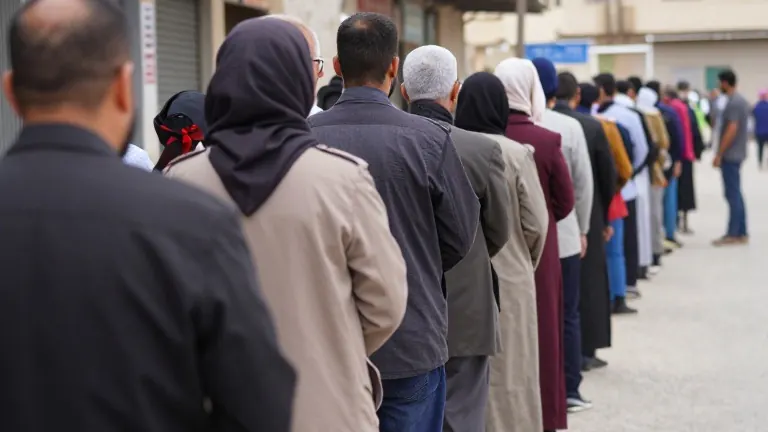
Voters in Israel cast ballots on Tuesday with a turnout of 77.7%, the highest rate recorded since 1999. The high participation did not resolve the political gridlock. As results came in, it became clear that neither the right-wing bloc nor the center-left opposition had secured the 61 seats required to form a majority government in the Knesset.
Prime Minister Benjamin Netanyahu’s Likud party is on track to win 28 seats. His coalition of right-wing and ultra-Orthodox partners, however, falls short of the necessary threshold. Gadi Eisenkot, the former army chief, leads the opposition. His party, Yashar, is expected to win approximately 22 seats. The broader change bloc led by Eisenkot is projected to hold around 47 seats, which is also insufficient to govern alone.
The Arab parties are positioned as potential swing votes. These parties are on pace to secure at least 17 seats collectively. Both major blocs campaigned on promises to exclude these parties from a governing coalition. Yet the arithmetic suggests one side may need to break that promise to form a stable administration.
Yohanan Plesner, president of the Israel Democracy Institute, noted that the change bloc working with Arab parties is a mathematical possibility. He stated that public opinion may be unprepared for such an alliance, especially since the October 7, 2023, Hamas-led raids reduced tolerance for Islamist partners. Another variation involves a minority government that relies on Arab support for key votes without including them in the cabinet.
A unity government between Netanyahu and Eisenkot remains a distinct possibility. Plesner suggested Netanyahu might lure a change bloc party into his coalition while retaining his far-right and ultra-Orthodox allies. Critics within the change bloc argue this would require Netanyahu to drop a far-right or ultra-Orthodox partner, creating a more centrist Zionist option. Eisenkot’s party campaigned on replacing the current prime minister, making a joint government a difficult sell to their voters.
If negotiations fail, Israel faces another round of elections. This scenario mirrors the political cycle from 2019 to 2021, which saw multiple votes before a center-left alliance ousted Netanyahu. For the incumbent, staying in place as interim prime minister during this process is a favorable outcome. Gideon Rahat, a political scientist at the Hebrew University of Jerusalem, said that given the entrenched camps, another election is the most likely path.
The formal process for President Isaac Herzog to receive recommendations for the next prime minister is expected to start next week. Plesner warned that the decision could take weeks or perhaps months. He noted that politicians might get creative in the coming weeks, but for now, the country remains without a clear mandate.
Source: The Jerusalem Post