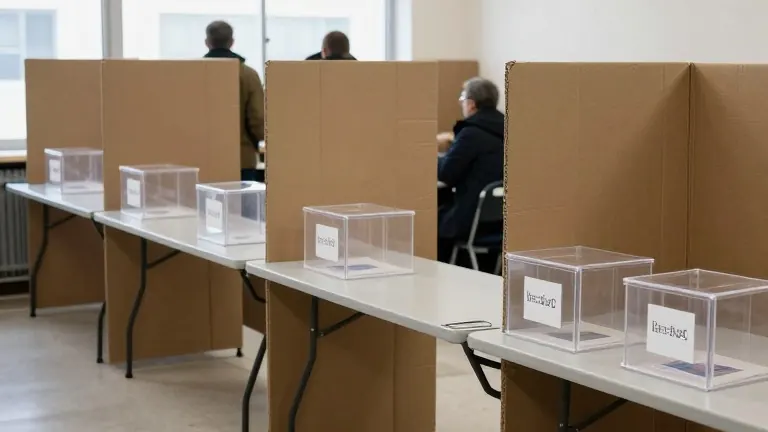
Exit polls show Likud as largest party, but coalition math remains difficult
Surge in Arab party seats creates a parliamentary majority against Netanyahu, yet conflicting campaign pledges threaten to block a governing cabinet.
By Emmanuel Ellis ·

Benjamin Netanyahu’s Likud party finished as the largest faction in Tuesday’s Israeli election according to exit polls released at 10 p.m. by Channels 11, 12, and 13. However, the party fell short of the support needed to form a stable government without partners that may be reluctant to join.
The polls indicate that the group of parties opposing the current government holds a majority of projected seats. This coalition of opposition parties defeated Netanyahu’s camp, yet they lack a unified agreement on how to govern. The primary obstacle is the strong showing by Arab parties, which won between 17 and 18 seats. Their votes prevented Netanyahu from securing a majority, but their inclusion would conflict with promises made by the opposition during the campaign.
Gadi Eisenkot, leader of the Yashar party, now commands the larger bloc of seats. He faces the same challenge Netanyahu faced in 2009 when the largest party did not automatically form the government. Eisenkot must decide whether to keep four specific conditions for coalition partners, which likely exclude the Arab parties, or if he will compromise to secure a cabinet. If he adheres to those strict terms, the numerical majority on paper may not translate into a working government.
One potential alternative involves bringing the two ultra-Orthodox parties into a coalition. They are projected to win 12 seats in total. Including them would solve the arithmetic problem of reaching a majority. However, it would create tension with promises to reform military conscription for that religious demographic. Another option is a center-right alliance consisting of Likud, Yashar, B’Yachad, and Yisrael Beytenu. These four parties would hold 67 seats. This arrangement avoids the haredi and Arab parties but requires Netanyahu’s rivals to serve under him.
The final vote count will determine if these projections hold. Until then, politicians must decide which campaign promises will survive the negotiation process. Voters made clear choices on Tuesday, but the parties must now determine if they are willing to change their conditions or partners to form a government. If no workable majority emerges, the country may return to the polls.
Source: The Jerusalem Post