Terror on Church Street: Orlando's Pioneering Haunted House
The attraction that introduced theatrical storytelling to the haunt industry operated for eight years in a former Woolworth's store.
By Zoe Ruiz ·
Terror on Church Street, the first American outpost of the European haunted house chain Pasaje del Terror, opened in Orlando in 1991. The attraction operated inside a semi-derelict former Woolworth's store at the corner of South Orange Avenue and Church Street. It closed on May 2, 1999, after rising rents forced the business to end its run.
Antonio and Ramon Riba, who later built Pirates Dinner Adventure, transplanted the concept from Spain to downtown Orlando. The chain was originally created in 1988 by Argentinian designers Fernando Quenard and Ignacio Brieva in Bilbao. Terror on Church Street officially inaugurated on Nov. 8, 1991, with a grand-opening appearance by actor Anthony Perkins.
The experience lasted approximately 20 minutes and took guests through more than 20 rooms across two stories. Groups of up to eight visitors entered the space at a time. The design featured immersive scenes inspired by gothic figures like Dracula and Dr. Jekyll, as well as modern cinematic slashers. The venue included an officially licensed Freddy Krueger character, a rarity before Universal's Halloween Horror Nights made intellectual properties common in the industry.
David Clevinger directed the in-house acting troupe known as the Eternal Dwellers. The group focused on theatrical techniques rather than simple jump scares. Alan Ostrander, who headed makeup and character design, noted that the production approached the haunted house from a theatrical standpoint. He stated that the crew did not use blood in the show, relying instead on implied violence and atmospheric tension.
Walter Price, who headed improv characters, emphasized that the attraction was a show with dialogue and narrative structure. He said that even short interactions told a story. Michael Gavin, an actor and box-office cashier, compared the detail of the sets to movie quality. He said the detail sometimes exceeded that of Universal's Halloween Horror Nights in its early years.
Street actors extended the experience outside the building. Jason Baerhold played Bongo, a clown character who entertained guests waiting in line. Brook Hanemann portrayed a character in a straitjacket and carried a stuffed cat. He described an incident where a fire truck stopped at the red light in front of the entrance. He placed his cat in a tree and begged the driver for help. The driver eventually climbed down to save the cat, prompting cheers from the crowd.
Alan Ostrander also performed outside as Roach, a monk character who chewed on cockroaches. He used a large picture window to position himself in the queue line. He would remain frozen for a minute before jumping up and hitting the glass to startle the waiting guests. Ostrander noted that police sometimes carted his character away in a squad car, placing him in handcuffs while in costume before dropping him back at the venue.
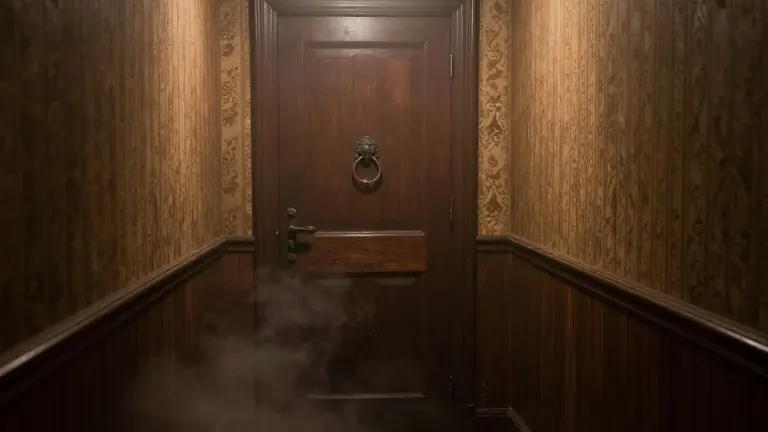
Jason Baerhold described the entry sequence where guests were instructed to follow three rules: no running, no stopping, and no photos. They walked through a Victorian alleyway to a door with a knocker. A voice told them the master would see them in the next room. A figure in a monk's robe greeted them as the eternal dwellers. The group then passed through a clanging gate with a chain, entering a graveyard with fog and sound effects. Zombies shuffled along a fence on the other side, taunted by guests, before charging the group.
Jack Neiberlein, the assistant director of operations, explained that quality control slowed the pacing. Guests entered in groups of eight and formed a single file line. They were told to place their hands on the shoulders or waist of the person in front to prevent contact with actors.
The original location was razed in 2003 to build the Plaza development. Most props and set pieces were auctioned off to Church Street Station for a short revival. Many elements eventually moved to Skull Kingdom, which operated on I-Drive from 1997 until 2006. Former cast and crew members continued to work in the haunt industry locally and internationally.
Source: Orlando Weekly
More Business · Bad Service · Report a business · Got a Story?