Study: LA Fire Smoke Carried Lead at 80 Times Background Levels for 7 Million
Caltech researchers found that smoke from the Eaton Fire contained toxic metals far above typical levels, exposing millions of residents during the Jan. 7, 2025, infernos.
By Hiroshi Davis ·
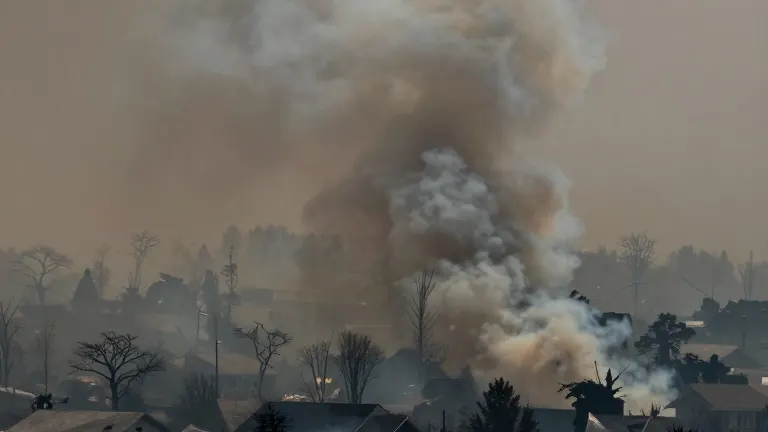
Seven million Los Angeles residents breathed air with lead concentrations 80 times higher than typical background levels during a single 24-hour period in January 2025, according to a study published Wednesday in Science Advances. The findings, produced by researchers at the California Institute of Technology, detail the chemical makeup of smoke from the Eaton Fire and compare it to data from a 2024 wildfire in Riverside County.
The study found that the urban smoke plume contained 50 times more lead, three times more arsenic, and seven times more halogens than the vegetation-focused fire. Nga Lee Ng, an author of the report, stated that the primary finding is that urban smoke is fundamentally different from wildfire smoke. Using the Atmospheric Science and Chemistry mEasurement NeTwork, or ASCENT, researchers tracked trace elements in fine particulate matter every hour. Ng noted the network is the first in the United States to measure airborne particle composition in real time.
The Eaton Fire and a separate blaze in the Pacific Palisades ignited on Jan. 7, 2025, killing at least 31 people and destroying more than 16,000 structures. The fires consumed homes, vehicles, and household materials, including paint, electronics, and furniture. Co-author Haroula Baliaka said the data fills a research gap by distinguishing the emissions from burning buildings. She added that as urban growth and climate change push fires into cities, emergency response systems will require adaptation.
Experts reviewed the data to assess health implications. Ed Avol, a professor emeritus at the Keck School of Medicine at the University of Southern California, called the exposure levels consistent with his expectations but surprising because such data had not previously been documented. He highlighted the study's hour-by-hour measurements as a key advantage over typical weekly sampling. Yaguang Wei, an assistant professor at the Icahn School of Medicine at Mount Sinai, said the results reinforce his prior work showing wildfire smoke particulates are more toxic than those from other sources.
Lead is a neurotoxin that can stunt development in children and raise blood pressure in adults. Arsenic is linked to various cancers. Scientists have not yet determined the specific health effects of short-term, high-level lead exposure. Wei stated the findings have policy implications and suggested governments invest in more monitoring, public alerts, and prescribed burns to mitigate risks.
Avol emphasized that residents will continue to use materials containing metals and halogens in their homes. He said the study serves as a reminder to think about how to minimize exposure in a world where urban and wildland environments increasingly intersect and catch fire.
Source: WCCB